Thursday, August 13, 2009

Origin of Indian Music: 1400 BC

Fig. a: Forms of Music in Ancient India (as depicted in Natyashastra composed around 1st century AD)


Oldest Legacy of Music

Indian movies are often considered silly and unrealistic in the west because of the excessive song and dance sequences. Even now the most serious movies in India can't be thought without any song. Music, and songs are so much part of our culture and civilization that, irrespecttive of what others perceive of us, we can't do away with it. Everything - from marriages and worships to mourning or victory ceremonies - is incomplete without music, specially songs. For so many thousand years music has been so much a part of everything that it's really impossible to take it out of us. In fact we, as a civilization, have the oldest tradition of music in the world. No other civilization or culture has an uninterrupted legacy of music for close to 4000 years.

Music has been always an integral part of spirituality, religion, art and entertainment in any civilization and culture. But the position, influence and stature of music in Indian civilization is no doubt much more crucial than that anywhere else. Apart from the antiquity the varied hues and colors, that poured into India's palette for the past 4000 years, gave rise to a dazzling and gorgeous plethora of a stunning and matured music. No other civilization ever had such a long and uninterrupted tradition of music. Perhaps that's one of the reasons why music is so deeply rooted into us.

This long tradition of Indian music can be traced back to the early Vedic Age, since the time of Rig Veda.

Like the light and air, music has existed ever since the world was created. It might be preposterous to claim that before the Vedic Age there was no music in India. Music is as old as life and it existed in all civilizations in all ages in some form or other. Any natural sound is melody to ears. The chirping of the birds, the flowing of the rivulets, the sound of the breeze, the roaring of the seas, the falling of the rains - everything is music and has always mesmerized the living beings, both humans and animals. Humans have always endeavored to create the same melody that they have heard around them. But archaeological evidences of all those early endeavors of mankind are mostly lost. The Vedic music, which in turn had imbibed many of the legacies and practices from the Indus Valley and other native civilizations and cultures, may be treated as the most ancient tradition of music that didn't get lost. The present day Indian Classical Music can trace back its origin to the Vedic chants of the Vedas.


Rig Vedic Music

Rig Veda, the first of the four Vedas are thought, though controversially, to have been composed around 1500 BC. Though compiled or written much later, there did exist a strict way of chanting the hymns of Rig Veda. If we consider 1500 BC (16th century BC) as the rough period of composition of Rig Veda, we may assume that in 15th century BC the Rig Vedic chants would have attained a definitive shape. This tradition of chanting, like the complete texts, has been preserved very authentically by successive generations of Brahmins for nearly 4000 years. This chanting style is the earliest form of Indian and world music.

The two earliest treatises on Indian Music - Natyashstra (1st century AD ??) and Naradiyashiksha (5-6th century AD ??) - provide some good information about Vedic chants, specially the Sama Gana or the Songs of Sama Veda.

Three different pitches or accents or swars - udatta, anudatta and swarita - were used for chanting Rig Veda. Even today in Bengali, the language that has retained the maximum words from Sanskrit among all the descendants of Sanskrit in India, the term "udatta kantha" means a voice which can sing freely and loudly without any inhibition. That's exactly what it meant also in the context of chanting the Rig Vedic hymns. Udatta was the principal accent, a raised one, for the chant. Preceded by udatta was the anudatta - which literally means 'that which is not udatta' - an accent not raised. The third accent swarita - meaning sounded - was a transitional one marking the transition from a raised to unraised accent. For many centuries, till the Rig Veda was finally written down, the accents were represented by signs with the fingers of the hands. This is the earliest form of notation in any music in the world.

Much later after the advent of scripts, when the Rig Veda was finally written down, a very simple form of written notation was used. This is again the earliest form of written notation in the world. In Rig Vedic texts udatta (U) is not marked with any notation, anudatta (A) is marked with a horizontal line under andswarita (S) with a vertical line above the syllable as seen in the first verse.

agnim ile purohitann yajnasya devam rtvijam |
hotaaran ratnaghaatamam || 1 001 01

I Laud Agni, the chosen Priest, God, minister of sacrifice,

The hotar, lavishest of wealth.

Fig. b: 1st verse of Rig Veda

The three different accents indirectly correspond to three different pitches. Various recensions use different pitches for these accents. The staff notation of a typical Vedic chant in one of the recensions - whereanudatta has the lowest pitch (G flat), udatta the middle (A) and swarita highest (B flat) - is presented below.

Fig. 1: Staff Notation of a Rig Vedic Chant

This particular style of using three consecutive notes alternatively is perhaps the earliest form of Indian music, the legacy of which can be still visible in the Dhrupad style of Hindustani Classical Music. Though the term 'Dhrupad' is much new compared to Rig Veda, nevertheless, the style remained in some form or other in Indian music. Figure 2 below depicts in staff notation the 'Alaap' or the first movement of three Raagas sung in Dhrupad style. The Rig Vedic pattern of the usage of three consecutive notes is quite visible in these notations

Fig. 2: Staff notation of 'Alaap' in Dhrupad style, as in Sangita Parijata (17th century)

In the early treatises on Indian music (Fig. a), the Rig Vedic chants were classified as natya (drama) ofpathya (recitation) type. Drama was considered an important element of music. So the Rig Vedic chants not only gave form to the earliest Indian music, but also to the earliest Indian drama. Indeed the Rig Veda contains all the elements of drama - characters, events, narration, emotions, actions etc. The pitch modulation through raised (udatta), unraised (anudatta) and the transitional (swarita) accents originated to give expression to dramatization of the Rig Vedic chants. The relation between drama and music has been always very strong in India in all ages and the Rig Veda might have created that close association for the first time.


Sama Vedic Music

The Sama Veda is believed to have been composed between 1400 BC and 1100 BC. The Sama Vedic chants took the proper form of music over time. To facilitate singing of the verses the three accents or pitches or notes of the Rig Vedic chants eventually expanded to a full fledged scale of seven-notes and twenty two intermediate tones (shruti) of varying pitches. The Naradiya Shisksha is a very good treatise on Sama Vedic music. It speaks of the origin of each of the seven notes from natural sounds produced by animals and birds. Apart from the seven notes of the scales there were also the five qualitative types of tonal color (bright, extended, mournful, soft and moderate). Each of the seven notes was assigned one of the five qualitative tonal color and also one of the three Rig Vedic accents. So if you needed to express sadness in a low (unraised) voice then there was a note for you matching your requirement. This can be seen as the earliest foundation of the Indian Raagas, which is a much later concept in Indian music than 1400 BC.

In the absence of any written text of Sama Veda in the initial years, the seven notes were represented by seven signs with fingers - an extension to the three signs used in Rig Vedic chant. When texts came into being, the seven signs were represented by the seven numerals. starting from one. As seen in the Fig. 3 below the first note - referred to as krushta, meaning loud note - was Madhyama or Ma.

Fig. 3: Sama Vedic Swaras (Notes)

A very interesting thing about the Same Vedic scale is that it's a diminishing one in contrast to what we've now in all the styles of music in the world. The scale used to start from Ma and end at Pa instead of starting from Sa and ending at Ni. In later times the scale was changed from 'Ma Ga Ri Sa Ni Dha Pa' to 'Sa Ni Dha Pa Ma Ga Ri' - with the Sa in the higher octave - to allow for the usage of higher notes for better audibility. Also at later times the scale was converted from the diminishing to the present day ascending one.

Fig. 4: Staff notation of a typical Sama Vedic Scale

One very interesting thing of the Sama Vedic music is the modification and addition of syllables to the original texts, which themselves are derived from Rig Vedic verses, to fit into singing styles. In contrast to the rigidity maintained for the pronunciation and accents of the Rig Vedic verses this is indeed a very remarkable change for the sake of music. Such flexibility is perhaps the biggest asset of Indian music till date. No other book, considered sacred in any other religion, has been allowed to be altered so much just for the sake of music!!

The original Sama Vedic texts (known as Samhita) can be chanted in the same way as Rig Veda with the three Rig Vedic accents, which are represented (or notated) in Sama Veda by numerals - udatta is 1, swaritais 2 and anudatta is 3.

namaste agna ojase grinanti deva krishtayah
ameramitramardaya

O Agni, God, the people sing reverent praise to thee for strength:
With terrors trouble thou the foe

Fig. 5: Original text of Sama Vedic Verse 1.1.1.02.1 (Kauthuma Samhita) with 1, 2 & 3 for Udatta, Svarita & Anudatta notes

The Sama Vedic song books had two flavors - Gramageya or 'songs for village singing' and Aranyageya or 'songs for forest singing' both adapted from different portions of the Sama Veda Samhita (texts). Fig. 6 shows the song adaptation (along with numeric notation) of an original Sama Vedic text (Fig. 5). It can be noted that the word 'namaste' in original text (Fig. 5) is converted to 'namastau' (Fig. 6) in the song adaptation. Similarly 'agna' is converted to 'hognaai'. Sylables like 'au', 'ho' and 'vaa' are also added for the sake of singing.

Fig. 6: Notated song 20 of 'Gramageya' song book of Sama Veda, derived from 1.1.1.02.1 of Kauthuma Samhita

I've created a very simplified staff notation (Fig. 7) for the above song in Fig. 6 based on some simple principles of the Sama Vedic notation as follows:

  • Numerals 1-7 denote the seven Sama Vedic notes in a diminishing scale (considered here as the C major scale)
  • Numerals above any syllable denotes the pitch/note used for pronouncing/singing that particular syllable
  • Numerals within the text denote elongation of the preceding vowel
  • In general simple vowel has a single beat duration. The compound vowel has a three beat duration by default, but two beat if notated with an additional 'r' along with the numeral on top of the syllable
  • A '^' on top of the syllable means a three beat duration

Fig. 7: Simplified Staff notation of song 20 of 'Gramageya' song book of Sama Veda

In contrast to the simple notation of Fig. 7, in reality the Sama Veda is sung in a much more complicated way (with kampan or vibrato) as depicted in Fig. 8 below.

Fig. 8: Detailed Staff Notation of song 20 of 'Gramageya' song book of Sama Veda (as sung in the Ramanna style by Sri Sesadri Sastrigal & transcribed by Wayne Howard)

The sequence and combination of notes in the above notations clearly point to the same in Indian Raagas, developed much later. Starting from the seven notes and scales to the sequence of notes, the legacy of Sama Vedic music is omnipresent in Indian Classical Music in various forms.

Though the Sama Vedic music reached a great height even at such an early stage of Indian civilization around 1400 BC, still the concept of 'taal' or beat was still unknown. The duration of a single beat note was not fixed and changed from syllable to syllable.

Reference & Useful Links

  1. Sama Veda
    • 'Gramageya' song book of Sama Veda in Devanagari: It contains fully notated musical adaptation of the Sama Veda Samhita. Perhaps this is the earliest available book of songs with complete notations
  2. The Garland Encyclopedia of World Music - South Asia: Indian Subcontinent by James Porter, Timothy Rice & Chris Goertzen: Has good information about the early phases of Indian Music including details of early musical treatises like Natyashastra & Naradiya Shiksha
  3. A History of Indian Literature by Moriz Winternitz & V. Srinivasa Sarma
  4. The Music and Musical Instruments of North East India by Dilip Ranjan Barthakur: Contains good information about music of Sama Veda and the instruments in Vedic Age
  5. Dhrupad by Ritwik Sanyal & Richard Widdess: Has staff notations of Dhrupad styles and references to Rig Vedic Music as the origin of Dhrupad music
  6. Ragas in Indian Classical Music by Anupam Mahajan: Good reference for Naradiya Shiksha and other works attributed to Narada
  7. The Music of India by Reginald Massey: The chapter on "Vedic Heritage" has good information about Vedic music and early scales
  8. Music in Sama Veda - blog by Sreenivasa Rao S with many useful information
  9. Artcile by Srini Pichumani

Friday, June 12, 2009

Beginning of Iron Age, Atharva Veda: 12century BC

Later Vedas

Like the Rig Veda, the only sources for the post Rig Vedic history of India are the later three Vedas - Yajur, Sama & Atharva Veda. There is no concrete proof of the timelines of these three Vedas. Commonly accepted chronology is that Yajur Veda and Sama Veda, composed perhaps between 1400 BC and 1100 BC, are older than Atharva Veda which was composed perhaps between 1100 and 900 BC. The present forms of all the four Vedas didn't take place for sure within these time frames. It had taken several more centuries before they would have arrived to the present forms. Yajur Veda has reference to fully developed caste systems, considerable advances in art, handicrafts, trade and occupation, which are evidently of much later date of early first millennium.

The four Vedas Rig, Yajur, Sama and Atharva are the earliest literatures of mankind. They also form the basis of the way of life that gradually metamorphosed into a religion, commonly and also erroneously at times, known as Hinduism. At their core the four Vedas are just books of knowledge and enlightenment as realized by the learned people of the time and presented in forms of manuals for rituals - mostly worship of natural forces. Rig Veda is the Knowledge of Recited Praise, Yajur Veda the Knowledge of Sacrifice, Sama Veda the Knowledge of Chanted Hymns and Atharva Veda the Knowledge of Prayers, Charms and Spells. Apart from Yajur Veda, all the other three were composed as perfect metrical verses. Many verses of Rig Veda are reused in various forms in all the other three later Vedas.

Almost all the ancient civilizations were worshipers of nature and natural forces. So it's nothing extraordinary or exceptional for the Indians to worship fire, water, sky, wind and earth - the five basic natural forces. At the dawn of civilization, when the human race was still under the spell of the powers and mysteries of the nature, it's very natural that most of her rituals would be centered around pleasing these mysterious forces. Metaphorically each of these forces was given a shape and form of super humans or Gods. All the knowledge, be it about philosophy or environment or mathematics or governance were packaged into the widely respected ritual manuals. Though the Vedas are regarded as religious books, still they have wealth of valuable information and knowledge and tremendous literary value. None other religious books in any other religion has such great value beyond the dogmatic significance. Most of the content in Vedas are relevant even now. That's precisely what makes the Vedas so unique. Most importantly the history of ancient India is impossible to construct without the Vedas.

Yajur Veda

It's quite fascinating to know that some 3000 years ago Indians were equally concerned about the harmony between man and nature. Yajur Veda speaks about being "in accordance with the earth". It also talks about an all inclusive growth of mankind "spreading with a hundred branches".

Shukla Yajur Veda: 5.43


dyaammaa lekheerantarikshammaa himseeh prithivyaa sambhava |

ayam hi tvaa svadhitistetijaanam praninaay mahate saubhaagaaya |

atastvandeva vanaspate shatavalsho viroha sahasravalshaa vi vayan ruhema |


Graze not the sky. Harm not mid-air. Be in accordance with the earth.

For this well-sharpened axe hath led thee forth to great felicity.

Hence, with a hundred branches, God, Lord of the Forest, grow thou up.

May we grow spreading with a hundred branches.

The following verses from Shukla Yajur Veda mention the numbers upto ten raised to the power of 12 in steps of powers of 10, namely ayuta(10 raised to the power 4, or 10K), niyuta(100K), prayuta(1million), arbuda(10 million), nyarbuda(100 million), samudra(1billion), madhya(10 billion), anta (100 billion) and parardha(1trillion).

Shukla Yajur Veda: 17.2

imaa me'agna'ishtakaa dhenavah santvekaa cha dasha cha dasha cha shatancha shatancha sahasrancha sahasranchaayutanchaayutancha niyutancha niyutancha prayutanchaarbudancha nyarbudancha samudrashcha madhyanchaantashcha paraadheshchaitaa me'agna'ishtakaa dhenavah santvamutraamushmilloke

O Agni, may these bricks be mine own milch kine: one, and ten, and ten tens - a hundred, and ten hundreds - a thousand, and ten thousand - a myriad, and a hundred thousand, and a million, and a hundred millions, and an ocean middle and end, and a hundred thousand millions, and a billion. May these bricks be mine own milch-kine in yonder world and in this world.


A similar list is available inTaittiriiya Samhita[Krişhņa Yajur Veda] (4.4.11) and (7.2.20.1), Maitrāyaņi Samhita 2.8.12, Kathaka Samhita (17.10) etc. The Atharvaveda Samhita (6.25.1 thru 6.25.3, 7.4.1) specially emphasizes the common relationship between one and ten, three and thirty, five and fifty, nine and ninety, clearly indicating that the persons of the Vedic age had a good grasp of the basics of decimal system for positive integers.


The number four three two (four hundred and thirty two) million occurring frequently in
Sanskrit works occurs in Atharva Veda (8.3.21).

Yajur Veda also has the first reference to numeric infinity (purna or fullness) stating that if you subtract purna from purna you're still left with purna.

It's quite a unique development in the filed of science and mathematics on the part of the Indians compared to all their contemporaries. At the same time it's quite confusing to know that the same people, who had such in depth knowledge about mathematics lacked the knowledge of technology. The people of Indus Valley Civilization might not have know such level of mathematics, but they were masters in technology of town planning, navigation, ship building and many others.

Sama Veda

Sama Veda is the first book of songs known to mankind. It forms the earliest foundations of Indian Classical Music. It also sets the earliest legacy of using songs as a form of worship, which over the ages has been proved to be the most popular form of worship in all religions. Music and sound not only play an important role in spirituality, but also in our normal lives. Sama Veda uses the sound, lyrics and music in a wonderful way to create the right aura and ambiance for spirituality and divinity.

Sama Veda: 4.9.2.7


namah sakhibhyah poorvasadbhyo namah saakannishebhyah |

yunje vaacham shatapadeem ||

yunje vaacham shatapadeem gaaye sahasravarttani |

gaayatram traishtubham jagat ||

gaayatram traishtubham jagadvishvaa rupaani sammritaa |

devaa okaamsi chaktrire ||


Praise to the friends who sit in front! to those seated together, praise

I use the hundred-footed speech speech.

I use the hundred-footed speech, I sing what hath a thousand paths,

Gayatra,Trishtup, Jagat hymn.

Gayatra, Trishtup, Jagat hymn,the forms united and complete,

Have the Gods made familiar friends.

Atharva Veda

Atharva Veda, the last of the four Vedas, is often criticized for dealing with super naturals. But philosophically it's perhaps much more deeper than the other three Vedas. It, no doubt, deals with topics more complex in nature.

It's the first Vedas that speaks about medicine and physiology. The first book of Atharva Veda speaks of the following:

Hymn 2: A charm against dysentery

Hymn 3: A charm against constipation and suppression of urine

Hymn 4: To the waters, for the prosperity of cattle

Hymn 5: To the waters, for strength and power

Hymn 6: To the waters, for health and wealth

Hymn 11: A charm to be used at child-birth

Hymn 22: A charm against jaundice

Hymn 23: A charm against leprosy

Hymn 24: A charm against leprosy

Hymn 25: A prayer to fever, as a charm against his attacks

Hymn 26: A charm to obtain invisibility

The following verses speak about the importance of Sabha and Samiti, the two popular forms of meetings during the Vedic Age. It's again an early example of argumentativeness of the Indians. The main purpose of these meetings was to discuss things of relevance openly in a common forum. The importance of such meetings is great in the proper governance of a country. It's clear from this verse that these meetings were taken quite seriously by the people. It's being pointed out that everyone should be fair in their words and every man should respect every other man in these meetings.

Atharva Veda: 7.12.1

sabhaa cha maa samitishchaavataan prajaapaterduhitarau sanvidaane |

yenaa samgachchhaa upa maa sa shikshaanchaaru vadaani pitarah sangateshu ||


In concord may Prajapati's two daughters, Gathering and Assembly, both protect me.
May every man I meet respect and aid me. Fair be my words, O Fathers, at the meetings.


The following verse speaks about atoms as the smallest unit of any object.

Atharva Veda: 12.1.26

shilaa bhumirashmaa pamsu saa bhumih samdhrita dhrita |

tasyai hiranyavakshase prithivyaa akaram namah ||


Rock earth, and stone, and dust, this Earth is held together, firmly bound.

To this gold-breasted Prithivī mine adoration have I paid.


Here 'atoms' (Pāṃsu) are described forming the stone, the stones agglutinating to form the rocks and the rocks held together to form the Earth. This is quite a unique realization made by the Indians some 3000 years back.

Most importantly Atharva Veda refers to Iron as a metal for the first time, thus heralding the start of the Iron Age and the end of Bronze Age sometime around 1100BC.

Atharva Veda: 11.3.5, 6, 7

ashvaa kanaa gaavastandulaa mashakaastushaah ||5||

kabru faleekaranaah sharo'bhram ||6||

shyaamamayo'sya maamsaani lohitamasya lohitam || 7||


Horses are the grains, oxen the winnowed ricegrains, gnats the husks. (5)

Kabru is the husked grain, the rain cloud is the reed. (6)

Grey iron is its flesh, copper its blood. (7)

The above hymn is in glorification of Odana or the boiled rice, a staple diet for most Indians even now. It glorifies Odana metaphorically in many ways by saying that Brihaspati is its head, Brahma the mouth, Heaven and Earth are the ears, the Sun and Moon are the eyes, the seven Rishis are the vital airs inhaled and exhaled, and so on.

Atharva Veda mentions the Kuru King Parikshita. The Kuru dynasty would have been an important one in northern India around 1100 BC.

Around the World

Early Vedic Age is contemporary to 18-20th dynasties of New Kingdom of Egyptian Empire. Around 1100 BC Greek City States, Troy being one of the most important ones, came to a spectacular end. The Homeric Trojan War is also believed to have occurred sometime in the 12th century BC.

In west Asia the Kassites have been ruling in Babylon since 16th century BC. Their rule came to an end in 1155 BC when it fell to
Elam (Iran). Finally after five centuries Babylon was conquered back by native ruler Nebuchandrezzar I in 1125 from the Kassites. Around the same the Hittites (Turkey) were
declining and the
Assyrians becoming more and more powerful. The first Assyrian Empire was established around the same time. Also Israel was getting formed.

Reference and Useful Links


Wednesday, March 18, 2009

The Battle of Ten Kings


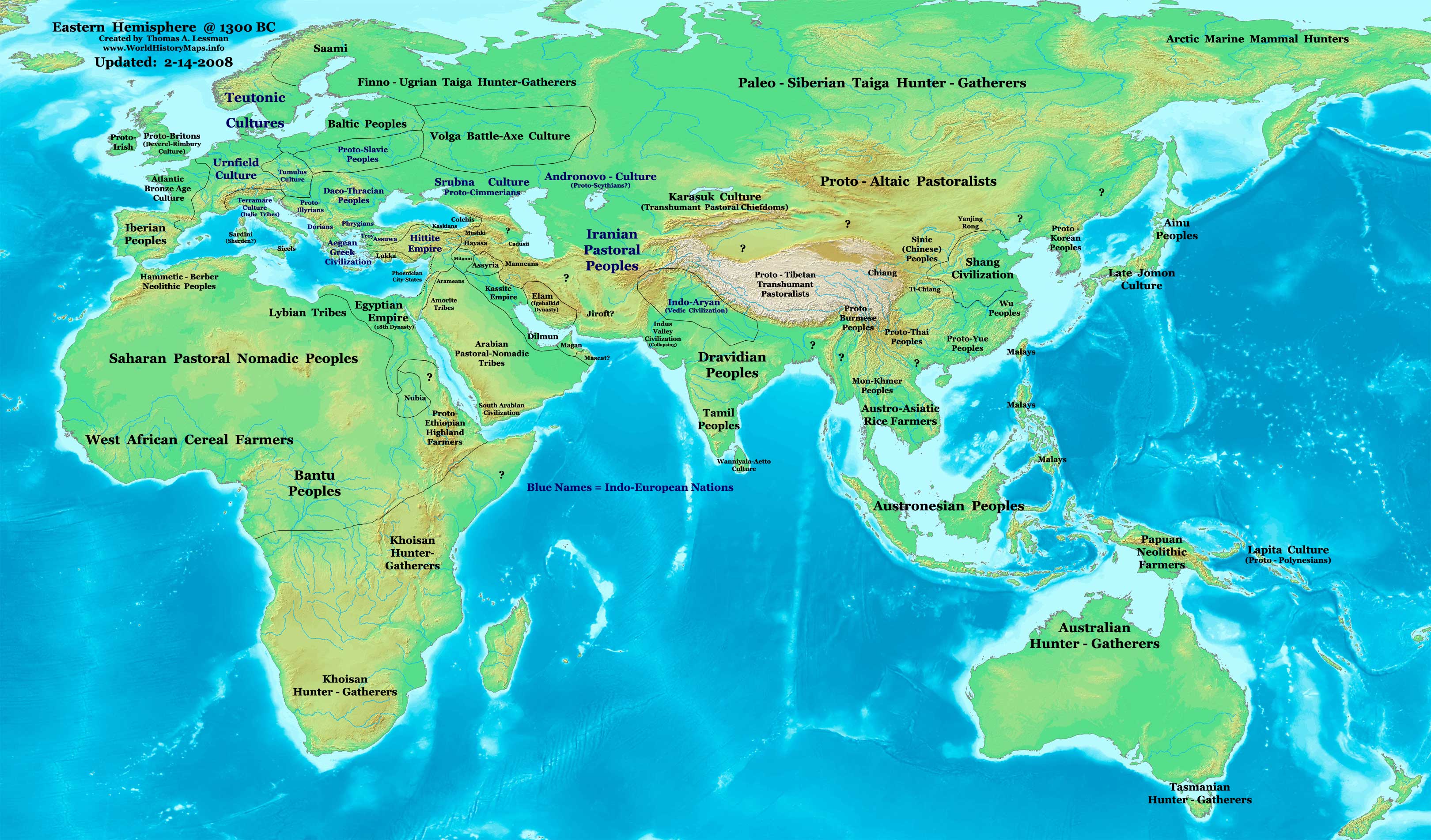
India and sorroundings: 1300BC; (c) www.WorldHistoryMaps.info

Socio-economic conditions in India in 1300 BC

The Aryans (or the Indo-Aryans, the descendants of the Indo-European and Indo-Iranians) started migrating into India since 1700 BC through Gandhara region, present day Swat in Pakistan. The prosperousIndus Valley civilization was declining at that time. The incoming Aryans came in some sort of conflict with the people of Indus Valley, who were gradually getting scattered throughout India. Though historical and archaeological records suggest that the earliest Aryans settled in Punjab since 1600 BC, it's not unlikely that the Aryans entered into India across several centuries. The Aryans settled in Punjab were indeed the composers of Rig Veda since 1500 BC, but earlier Aryans could have entered deep inside into India even before or around 1500 BC. The Aryans were nomadic and pastoral people moving and settling in groups. Unlike the people of Indus Valley, they didn't know the art and science of urban dwelling. They stayed in villages and constructed houses with woods and other easily perishable materials. Perhaps that's the reason why there's absolutely no archaeological evidence of the Aryans, where as the cities of the earlier Indus Valley civilization didn't perish even after 5000 years. The only accounts of the life and society of the early Aryans can be constructed from their literature - the Vedas, the Upanishads and the epics Ramayana andMahabharata.

It can be argued that literature can't be treated as historical accounts. But it's also true that only till recent past, most of the works of literature used to be period dramas, based on some historical events. Most ofShakespeare's works are based on historical events. Same is the case with Kalidas' works. Most early literatures across the world in any language used to derive their content directly from interesting historical events. In some cases they were also based on mythology, but then mythologies are also some sort of literary creations of even more ancient periods. So it's always possible to segregate the historical content from the imaginations of the writers. Each and every dialogue between Julius Caesar and Cleopatra, as depicted by Shakespeare, may not be accurate from historical point, but most of the characters and the chronology of events are indeed historical. Even if some of the characters are not historical, but the depiction of the society, the lives of the people and the political and economic conditions of the nation and kingdoms are very accurate in most cases. Even in the accounts of Sherlock Holmes Arthur Conan Doylegave a very true picture of London and England of the 19th century. So it's not unrealistic to depend on Rig Veda for an account of the earliest Aryans in India. Even if we discount the authenticity of the names of the Kings and Kingdoms still we can get a picture of the Aryan society of that period.

Rig Veda speaks about several confederation of tribes, many of which are referred to as non-Aryans - which can be either the native people of India like that of the Indus Valley or the earlier Aryans. The initial few years, since the Aryans started entering into India in 1700 BC, are marked with several conflicts - between the different Rig Vedic tribes, and also between the Rig Vedic and non Rig Vedic people. These conflicts are mainly for control over more pastures. The tribes were generally led by kings chosen democratically by the people but the kingship also became hereditary at many places. There was no direct form of taxation for the people. Warfares provided one of the main sources of accumulating wealth for the kings. The plunders of the wars were also shared among the people. Apart from the accumulation of wealth there was also the urge for consolidation.

Such warfares among the various tribes were not unique to India. Even in Mesopotamia there were continuous warfares between the various city states till Hammurabi consolidated most of them underBabylonian Empire (Iraq) in 1700s BC. He drove the Elamites (Iranians) out and created quite a big Empire. The Kassites (Iran) attacked Babylon in 1600s BC during the reign of Hammurabi's son. In the mean time the Indo-European Hittite Kingdom (Turkey) were gaining prominence to the west of Babylon which finally fell to the Hittites in 1532 BC. By that time the Kassites had already gained control over the northern part of Babylonia. By 1475 BC they gained control over the southern part also. By 1300s BC the various kingdoms ruling over middle east were Kassite (Iraq), Elam (Iran), Assyria (Syria), Hittite (Turkey) and Mittani, the Hurrian speaking vassal of Hittite, to the west of Assyria. It's not something exceptional that at the same time in India the various smaller kingdoms or confederations of tribes were involved in constant flights with the urge to create a consolidated empire in India. Also that was the period when the culture and language of the Aryans were influencing most of the native people in Northern India. Though the Aryans were a minority compared to the native people, still in due course most of the earlier languages and cultures were finally absorbed into their language and culture. It's very likely that all these amalgamations would be associated with conflicts and confrontations between opponent parties. Nevertheless, none of these conflicts can be termed as Aryan invasion. These conflicts were just natural events in course of amalgamation of different languages and cultures.

Battle of Ten Kings

The Rig Veda mentions a battle of ten Kings in the various hymns. An interesting one is the 18th hymn in book 7 (7.18)

purolaa it turvasho yakshur aasheed raaye matsyaaso nishitaa apeeva |
shrushtim cakrur bhrgavo druhyavash ca sakhaa sakhaayam atarad vishuco || 7.018.06

Eager for spoil was Turvaśa Purodas, fain to win wealth, like fishes urged by hunger.
The Bhṛgus and the Druhyus quickly listened: friend rescued friend mid the two distant peoples.


aa pakthaaso bhalaanaso bhanantaalinaaso vishaninah shivaasah |
aa yo anayat sadhamaa aaryasya gavyaa trstubhyo ajagan yudhaa nrn || 7.018.07

Together came the Pakthas, the Bhalanas, the Alinas, the Sivaas, the Visanins.
Yet to the Trtsus came the Ārya's Comrade, through love of spoil and heroes' war, to lead them.

This hymn (7.18) is dedicated to Lord Indra, who is mentioned to take side with King Sudas of the Trstutribe, fighting against at least ten other tribes. Eight of the tribes opposing Trstu, as mentioned in the above verse, are Druhyu, Bhrigu, Turvasha, Paktha, Bhalaanas, Alina, Vishanin and Shiva. Indra is referred to as the friend of Arya, 'Sadhamaa Aaryasya'.

The Bhrigu and Druhyu tribes are referred to as friends rescuing friends (sakhaa sakhaayam atarad) mid the two distant people (vishuco). They may be historically identified with the people of Central Asia (the site of the BMAC culture) - more specifically Bactria, present Balkh in Afghanistan and the Sanskrit Balhika of the epics. They are also sometime identified with the people of Gandhar, also in Afghanistan. Whatever be the true historical identification of the Drurhus the reference to 'distant people' may point to the fact that they are not native people. The Bhrigus, who are also 'distant people' along with the Druhyus, may be the people who eventually separate from the Rig Vedic Indo-Aryans and become the followers of Zoroaster, who himself may be one of the Bhrigus. There are striking similarities between the language and the content of the Rig Veda and the Avestan Gatha - the earliest books of the Zoroastrianism (present day Parsi religion) and believed to be composed by Zoroaster himself. Historically the Gatha is younger than Rig Veda and contemporary to Atharva Veda.

Paktha may be identified with present day Pathan or Pasthun or Pakhtun in Afghanistan. The Bolan Pass in Pakistan might have been derived from the Bhalaanas tribe. The Alinas are sometimes identified with the people of Nuristan in Afghanistan.


arṇāṃsi cit paprathānā sudāsa indro gādhāni akṛṇot supārā |
śardhantaṃ śimyum ucathasya navyaḥ śāpaṃ sindhūnām akṛṇod aśastīḥ || 7.018.05

What though the floods spread widely, Indra made them shallow and easy for Sudās to traverse.
He, worthy of our praises, caused the Simyu, foe of our hymn, to curse the rivers' fury.


The climax of the battle is fought on the banks of the river Parushni, the modern Ravi in Punjab. Sudas, the leader of the Tritsus crosses the river even though the flood is spreading wildly. Indra is praised for making the river shallow and thus facilitating Sudas to cross it easily. But Shimyu, the leader of the ten kings, fighting against Sudas, is swept away by the furious flood. He curses the river's fury.


īyur gāvo na yavasād agopā yathākṛtam abhi mitraṃ citāsaḥ |
pṛśnighāvaḥ pṛśninipreṣitāsaḥ śruṣṭiṃ cakrur niyuto rantayaś ca || 7.018.10

They went like kine unherded from the pasture, each clinging to a friend as chance directed.
They who drive spotted steeds, sent down by Pṛśni, gave ear, the Warriors and the harnessed horses.


ekaṃ ca yo viṃśatiṃ ca śravasyā vaikarṇayor janān rājā ni astaḥ |
dasmo na sadman ni śiśāti barhiḥ śūraḥ sargham akṛṇod indra eṣām || 7.018.11

The King who scattered one-and-twenty people of both Vaikarna tribes through lust of glory-
As the skilled priest clips grass within the chamber, so hath the Hero Indra, wrought their downfall.


adha śrutaṃ kavaṣaṃ vṛddham apsu anu druhyuṃ ni vṛṇag vajrabāhuḥ |
vṛṇānā atra sakhyāya sakhyaṃ tvāyanto ye amadan anu tvā || 7.018.12

Thou, thunder-armed, o’erwhelmedst in the waters famed ancient Kavasa and then the Druhyu.
Others here claiming friendship to their friendship, devoted unto thee, in thee were joyful.

These three verses give a graphical description of the war. The enemies, the warriors of the confederation of ten Kings, are running like unherded cattle. This may imply that most of the leaders of the enemies are killed and hence they are unherded, agopā. Kavasha along with the Druhyus are killed in the waters. Kavasha, referred to as famed and ancient - śrutaṃ, vṛddham - may be a Druhyu King and one of the leaders of the enemies. The reference to famed and ancient Kavasha may hint at the reputation of the Druhyus as a powerful and strong race of ancient times. Together with the reference to the Druhyus, also as distant people (mentioned above), it may be implied that they might have been a group of powerful and famous people much older than the composers of Rig Veda. None of the ten Kings, who are fighting against Sudas, is referred to as non-Aryan. Druhyu is in fact one of the 'five peoples' or Panajana or Pancakrishti(Yadu, Turvasha, Anu, Druhyu & Puru) of the Aryans. But still some of these tribes or peoples are considered to be older and distant compared to the others. This may imply that the Aryans migrated to India in waves - some came late and some early from near and distant places. As mentioned earlier the Druhyus can be identified with the people from the BMAC culture of Central Asia, the last phase of which preceded the Rig Vedic Age only by a few centuries.

In the first of the three verses above it's mentioned that the enemies are riding 'spotted horses', pṛśnighāvaḥ, brought by Prishni. Spotted horse or Appaloosa, is a horse breed - one of the oldest breeds known to humanity and depicted in cave paintings in Asia and China - which originated from Central Asia. It became a subject of art around 1400 BC in Egypt and Greece. It was also very important in ancient Persia, where it was worshiped. So from the timing of Rig veda and the probable dating of the battle of Ten Kings (around 1300 BC) it's likely that the 'spotted steeds' or pṛśnighāvaḥ might have come from Central Asia. Then Prishni, the person who brought these spotted steeds, might have been a King of the Druhyu or Anu or Bhrigu, all of whom may be identified with the people of Central Asia.

A later verse of the same hymn mentions the other two tribes in opposition - Anu and Puru. So the list of ten tribes are: Bhrigu, Druhyu, Turvasha, Paktha, Bhalanas, Alina, Vishanin, Shiva, Anu and Puru. All these Ten tribes are led by their respective Kings and thus making the Ten Kings. Few other tribes, like Aja, Yakshu and Shigru, are also mentioned, in connection to the Battle of Ten Kings, as oppositions. But they may not be led by their own Kings. Not all the Kings are named. Some of them may be Kavasha, Bheda and Prishni.

vi saddho vishvaa drmhitaany eshaam indrah purah sahasaa sapta dardah |
vi aanabashya trtsave gayam bhaag jeshma purum vidathe mrdhravaacam || 7.018.13

Indra at once with conquering might demolished all their strong places and their seven castles.
The goods of Anu's son he gave to Trtsu. May we in sacrifice conquer scorned Pūru


ni gavyavo anavo druhyavash ca shashtih shataa sushupuh shat sahasraa |
shashtir veeraaso adhi shad duvoyu vishved indrasya veeryaa krtaani || 7.018.14

The Anavas and Druhyus, seeking booty, have slept, the sixty hundred, yea, six thousand,
And six-and-sixty heroes. For the pious were all these mighty exploits done by Indra.

About Puru it's said that they speak a slang language - mrdhra-vaacam [language or vaacam of the mridhra]. A probable etymology for the word mrdhra or mleccha is interesting. The Babylonians referred to the people of Indus Valley Civilization as Meluhha, which may be the source of mleccha and mrdhra - both meaning "a foreigner, barbarian, non-Aryan, man of an outcast race, any person who does not speak Sanskrit". This makes sense only when we assume that the Aryans immigrated from outside into India, the native place of the people of Indus Valley. Here it may not be implied that Puru spoke the language of the people of Indus Valley. Probably they spoke some dialect which is different from that of the Tritsus - the people who won the Battle of Ten Kings. This logically leads to the idea that not all the Aryans spoke the same language. This goes well with the observation made earlier that the Aryans came in waves carrying with them different but still related cognate languages.

No doubt all these tribes did exist during the time of Rig Veda. It might not be illogical to place all these tribes and the battle around 1300 BC - little later than the period since the first Rig Veda was written in 1500 BC.

A very interesting thing in the last of the three verses is the use of six thousand synonymously with sixty hundred. This means that the Aryans used the same numeric system, the place value system, with ten as the unit - which we still use now and which was later evolved significantly into the modern day place value system by Aryabhat in 5th century AD and which traveled to Europe via Arab much later.

The above verse mentions that in the battle of ten Kings, the tribes Anu and Druhyu lost 6666 people. Though this figure might not be taken very seriously, but it's indeed a rough indication of the order of number of people belonging to any tribe in those days.

In another verse we get to know that the Tritsu wore white robes and made hair knots, like cowry shells, on the right sides of their heads.


ādhreṇa cit tad vekaṃ cakāra siṃhyaṃ cit petvenā jaghāna |
ava sraktīr veśyāvṛścad indraḥ prāyachad viśvā bhojanā sudāse || 7.018.17

E’en with the weak he wrought this matchless exploit: e’en with a goat he did to death a lion.
He pared the pillar's angles with a needle. Thus to Sudās Indra gave all provisions.


śaśvanto hi śatravo rāradhuṣ ṭe bhedasya cicchardhato vinda randhim |
martānena stuvato yaḥ kṛṇoti tighmaṃ tasmin ni jahi vajramindra || 7.018.18

To thee have all thine enemies submitted: e’en the fierce Bheda hast thou made thy subject.
Cast down thy sharpened thunderbolt, O Indra, on him who harms the men who sing thy praises.


āvadindraṃ yamunā tṛtsavaśca prātra bhedaṃ sarvatātā muṣāyat |
ajāsaśca śighravo yakṣavaśca baliṃ śīrṣāṇi jabhrur aśvyāni || 7.018.19

Yamuna and the Trtsus aided Indra. There he stripped Bheda bare of all his treasures.
The Ajas and the Sigrus and the Yaksus brought in to him as tribute heads of horses.


The above verses give some more details about how Sudas, leading the Tritsus, inflicts a decisive defeat on his enemies. Bheda, may be a King of the enemy tribes, is stripped off all his belongings and finally killed. Three other Kings or leaders from the enemy side - Aja, Shigru and Yakshu bring the heads of all the horses killed in the battle.

A very important thing that comes out in the first of the three verses is that this battle is a very skewed one - as if the goats (petva) are fighting against lions (siṃhya). This reminds of the skewed battle that the Pandavas fight against the mighty Kauravas in Mahabharata.

This Battle of ten Kings has striking similarities with the war depicted in Mahabharata. Both the wars are some form of civil war involving multiple parties with one side, the much weaker one, supported by some divine power and both are for consolidation of power over North India. In Mahabharata the weaker Pandavas are helped by Krishna and here Indra is helping the Tritsus. Keeping aside the divinity and other super natural elements in Mahabharata as poetic license, the historical elements are not very hard to identify. Various people have given different dates for the historical period of the Mahabharata War. The most logical period appears to be sometime in the 14th century BC, mentioned also by Jawaharlal Nehru in 'Discovery of India'. This period coincides with the probable period of the Battle of the ten Kings.


References

    1. Wikipedia
    2. 'Discovery of India' by Jawaharlal Nehru
    3. Book 7 of Rig Veda, which contains the hymn 7.18 about Battle of Ten Kings (in Devanagari)
    4. English translation of hymn 7.18 of Rig Veda - by Griffith
    5. Ancient Indian History and Civilization - by Shailendra Nath Sen (about the Battle of Ten Kings)